 January will mark not only the tenth year in the 21st century, but also the near completion of one-tenth of what was dubbed the New Millennium. At its turn, the year 2000 marked a new era of progress. In some ways it has been. We've seen a dawning of global awareness for conservation and natural resource preservation. And, we've begun to grasp the interconnectedness of the world and our need for international cooperation when it comes to natural resources. January will mark not only the tenth year in the 21st century, but also the near completion of one-tenth of what was dubbed the New Millennium. At its turn, the year 2000 marked a new era of progress. In some ways it has been. We've seen a dawning of global awareness for conservation and natural resource preservation. And, we've begun to grasp the interconnectedness of the world and our need for international cooperation when it comes to natural resources.
But we're still looking at the Mississippi River like it was sliced and diced according to geography, rather than the major North American river system. This approach - born of the limitations of a by-gone era when transportation and communication were limited and expensive - continues despite increased recognition that America's Waterway requires plans and actions as a whole.
Signs of progress for the Mississippi River as a system are appearing though. The Agriculture Department's Mississippi River Basin Initiative to allocate $320 million over four years and throughout 12 states is one sign. Potential legislation for whole watershed planning is another. And, Mississippi-River-based coalitions of museums, parks and economic development authorities have sprung up lately.
With 2010 in sight, it would be good to focus on the Mississippi River in its role as the Great American River and start to address its issues in that context. It would be a good time for all who have links to the Mississippi River - either by location or their jobs - to make new-year resolutions to look at the whole Mississippi River and think about it as a system. It is after all, America's Waterway and this year should be the year we start treating it that way.
New Thinking about the Role of Local Conservation
A Nov. 19. article in Nature, the international weekly journal of science, says researchers often focus mainly on publishing. International non-governmental organizations (NGO's) often select their agendas based on their need to raise money. These factors adversely impact the programs they decide to pursue. So, the editorial recommends researchers allow local government conservation agencies and other local organizations to set the broad agenda for natural resource programs. The basis for this? Conservation plans are more legitimate and politically acceptable when they are set locally.
The thrust of the editorial appears to be that there's an inherent link between conservation and its social and economic implications when research and programs are created and conducted close to home.
This may seem to contradict this newsletter's first article. However, whole-River approaches to the Mississippi River are possible by tapping local stakeholders by using technology and a representative, deliberative process such as the one we at America's Waterway advocate. Check out A National Dialogue for the Future of America's Waterway.
 Federal Grant for Power Generation Trials on the Mississippi River Federal Grant for Power Generation Trials on the Mississippi River
Free Flow Power Corp announced in December that it is awaiting word from the U.S. Department of Energy regarding $14.6 million in funding to support companies developing advanced water-power technologies. Free Flow plans 55 prospective sites for turbines in the Mississippi River in the 300-mile stretch between St. Louis and New Orleans. The project must still be licensed by the Federal Energy Regulatory Commission.
Christmas Bonfires Light the Way on the Mississippi River
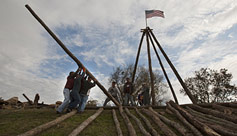 "Christmas bonfires on the Mississippi River" started showing up on Twitter in early December. If you're tracking River developments on Twitter, you probably noticed it, too. Turns out there's an interesting 200-year tradition in St. James Parish in Louisiana to light bonfires along the Mississippi to guide people to church on Christmas Eve (or to guide Santa Claus, depending on your translation). More than 100 teepee-shaped, 20-ft.-tall bonfires atop levees from Gramercy to Paulina light the way and are accompanied by folks who serve bowls of gumbo and jambalaya to neighbors and others. This year, the bonfires were threatened by high water, but the ban was lifted when water receded, setting off a flurry of jubilant tweets throughout the Internet. You can follow America's Waterway, too, on twitter at unifymissriver. "Christmas bonfires on the Mississippi River" started showing up on Twitter in early December. If you're tracking River developments on Twitter, you probably noticed it, too. Turns out there's an interesting 200-year tradition in St. James Parish in Louisiana to light bonfires along the Mississippi to guide people to church on Christmas Eve (or to guide Santa Claus, depending on your translation). More than 100 teepee-shaped, 20-ft.-tall bonfires atop levees from Gramercy to Paulina light the way and are accompanied by folks who serve bowls of gumbo and jambalaya to neighbors and others. This year, the bonfires were threatened by high water, but the ban was lifted when water receded, setting off a flurry of jubilant tweets throughout the Internet. You can follow America's Waterway, too, on twitter at unifymissriver. |